
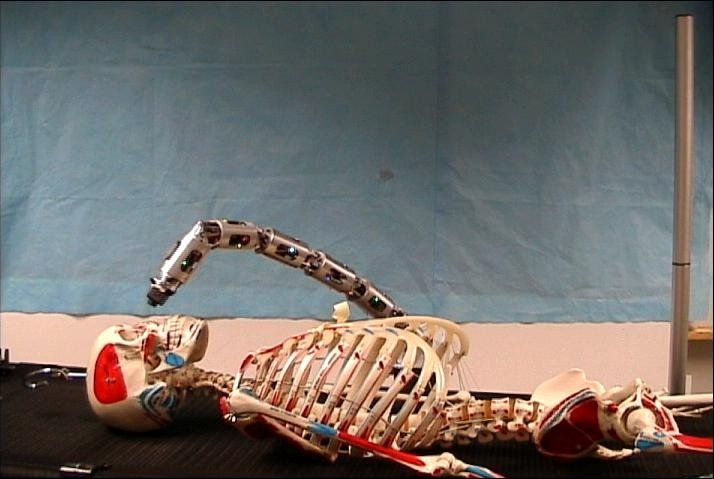
Life Support for Trauma And Transport (LSTAT)/Snake Robot
An increasing use of medical robotics is in the battlefield where medical robots are used to treat soldiers who are wounded in the frontline. One example of such robots is the Life Support for Trauma and Transport (LSTAT) /Snake Robot. The LSTAT is a portable surgical platform (stretcher) which integrates various state-of-the–art medical devices. LSTAT incorporates many functions of the Intensive Care Unit (ICU) such as a defibrillator, providing oxygen supply, analyzing blood, suction and physiological monitoring. These high-tech stretchers are currently being used by the US Army in
To further enhance the capability of the LSTAT,
- serving as a third hand for the medic
- moving an ultrasound probe under the control of a remote physician
- spraying antiseptics and antibiotics onto wounds

At present, Carnegie Mellon researchers have integrated built-in cameras onto the snake robot which allow for the inspection of a patient by remote physicians. The cameras which are mounted onto serpentine arms are preferred over the conventional method because it requires less sweep volume. Telemedicine (remote surgery) requires a dedicated connection bandwidth in order to minimize data lagging, which may affect the co-ordination between the doctor and the robot, hence affecting the patient. This has been resolved as LSTAT’s hardware capability is more than sufficient to handle the bandwidth issue.
How are military medical robots like in
References:
2. LSTAT/Snake robot description
3. TATRC Cutting Edge Medical Technology
4. Study of LSTAT integration to Robotics
*Would like to acknowledge the photos that I have posted. Thanks to those who produced it. Hope I don't get sued for copyright infringement.Blog entry posted by

No comments:
Post a Comment